My Observations on the Collatz Sequences 🔬
This page is dedicated to the unique patterns and curiosities I've discovered while exploring the Collatz Conjecture. None of these observations constitute a proof, but they offer intriguing insights into the behavior of the sequences.
1. Tower of Positive Integers
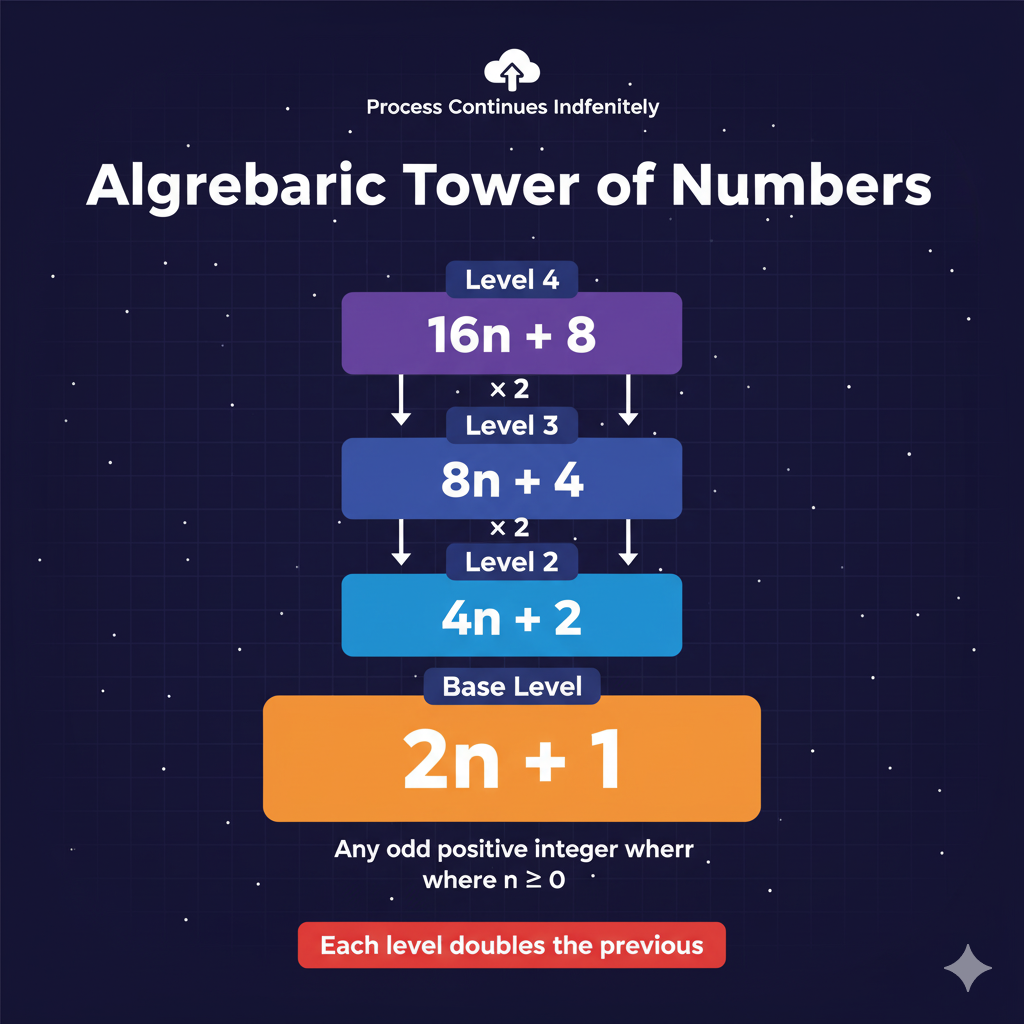
The structure of the Doubling Tower proves that every positive integer belongs to a unique tower. This works by recursively partitioning the set of even numbers (2n) at each power of two:
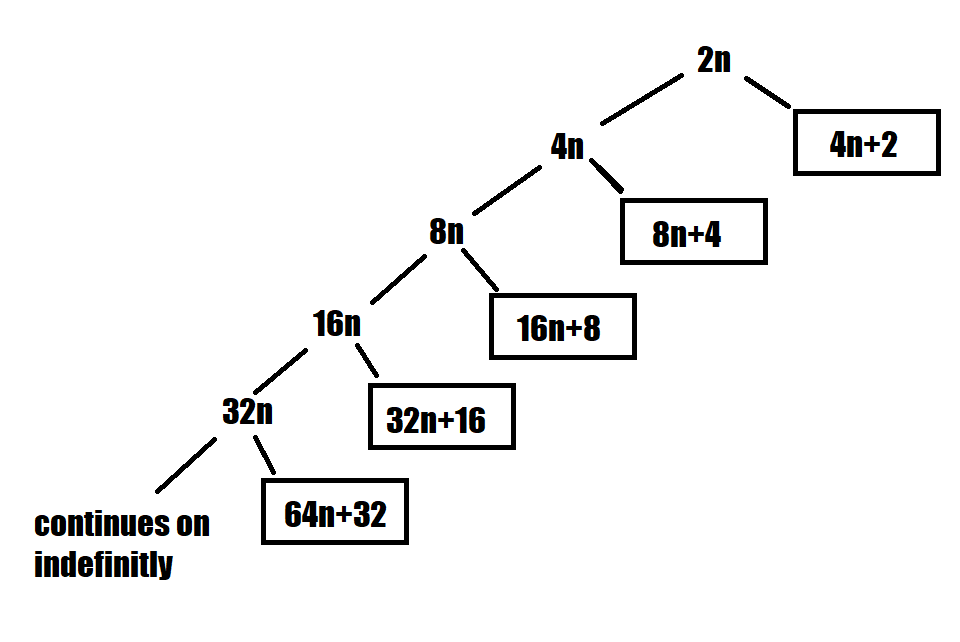
This **geometric progression** ensures that every single positive integer (odd numbers 2n+1 at the base, and every even number above it) is accounted for in the Collatz structure.
2. The Three Tower Types (Modulo 6)
We classify every odd number, which forms the base of a Doubling Tower, into three distinct categories based on its value modulo 3:
- Type $6n+1$: Bases like $1, 7, 13, 19, \ldots$ ($\equiv 1 \pmod 3$)
- Type $6n+3$: Bases like $3, 9, 15, 21, \ldots$ ($\equiv 0 \pmod 3$)
- Type $6n+5$: Bases like $5, 11, 17, 23, \ldots$ ($\equiv 2 \pmod 3$)
The Non-Branching $6n+3$ Towers
The **$6n+3$ towers are unique because they can never be reached by the $3N+1$ rule from a previous odd number.** Since the result of $3N+1$ is always $\equiv 1 \pmod 3$, and all numbers in a $6n+3$ tower are $\equiv 0 \pmod 3$ (multiples of 3), no connection is possible. **These towers only ever feed OUT to another tower.**
3. The Tower Connectors: Linking Odd Numbers
The Collatz tree is formed by the **$3n+1$ rule** connecting the odd base ($N$) of one tower to a specific even number ($R$) inside another tower. This number $R$ must be reachable via the reverse odd operation, $\frac{R-1}{3}$, which yields the original odd number $N$.
Algebraic Conditions for Connection Points
The connection points ($R$) only exist in towers whose bases are of type $6n+1$ or $6n+5$ and follow specific formulas where $p \ge 0$ is an integer representing the tower level above the base (level $2^1$):
The number $R$ must be congruent to $\mathbf{1 \pmod 3}$ to be the result of the $3N+1$ operation. Since $2 \equiv -1 \pmod 3$, multiplying by $2^k$ alternates the modulo 3 value:
The connection point $R$ for towers with a $\mathbf{6n+1}$ base.
The connection point $R$ for towers with a $\mathbf{6n+5}$ base.
By finding which level $p$ of the tower satisfies these conditions, we establish a precise algebraic relationship for every **Odd-to-Odd Connection** in the entire Collatz Tree.
4. Odd-to-Odd Step Counts (The Shortcut)
Analyzing the number of divisions by two ($\text{n}/2$) required to get from $3N+1$ back to the *next* odd number is key. This is where the shortcut formula comes from. For a given odd number $N$, the next odd number $M$ is defined by:
where $k$ is the number of divisions required to make the numerator odd. This formula essentially bypasses all the even numbers in the sequence, linking $N$ directly to $M$, and reveals the complex distribution of required steps ($k$) that determines the sequence's path.
5. The Doubling Tower and the Collatz Tree Spine
The tower rooted at **1** (a $6n+1$ type) is the **main trunk of the Collatz Tree**. This sequence, $1, 2, 4, 8, 16, 32, \ldots$, represents the final, unavoidable path all sequences must follow to terminate at 1.
6 The Path Equation
When we follow a specific path of n odd steps and m total steps, we aren’t just performing arithmetic; we are traversing a specific branch of this tree. This traversal generates a “Path Equation” that links the starting value $N$ to the terminal value $M$:
$$\frac{3^n N + f}{2^m} = M$$
7 How the Tree Generates the Constant $f$
The constant f is the most fascinating part of this equation. It is not a static number but a “path memory” generated by the sequence of turns.
If we define the path as a bit-string where 1 is an odd step and 0 is an even step, f is built iteratively. Starting at $f = 0$ $n = 0$ and $m = 0$:
• f remains unchanged
• n increases by 1
• m increases by 1
8 Decomposition into $3^a 2^b$
By expanding the recursive definition, we observe that $f$ is actually a sum of terms. Each term represents a specific "turn" taken during the path.
$$f = \sum_{k=1}^{n} 3^{n-k} \cdot 2^{v_k}$$
What does this mean?
- ● $n$ is the total number of odd steps in the path.
- ● $v_k$ is the total number of steps (even + odd) that occurred before the $k$-th odd step.
- ● The power of 3 ($n-k$) represents the "compounding interest" applied to that specific turn as it travels through the remaining odd steps of the tree branch.
Example: Path "101" (Odd, Even, Odd)
Initial $f=0$, $m=0$, $n=0$
- 1. Step 1 (Odd): $f = 3(0) + 2^0 = 1$
- 2. Step 2 (Even): $f = 1$ (stays same)
- 3. Step 3 (Odd): $f = 3(1) + 2^2 = 3 + 4 = 7$
Decomposed Form:
$7 = (3^1 \cdot 2^0) + (3^0 \cdot 2^2)$
9 The Significance
This reveals that $f$ is a determined by the path down the tree. Every possible path through the Collatz tree produces a unique $f$, which acts as the shift constant that slides the set of possible $N$ values into their resulting $M$ values. For nodes where one is a possible solution to its equation only one value of N makes that equation true.
10. Collatz Termiination condition and Constraint on valid values of N
Every complete sequence that terminates at a power of 2 ($2^m$) must satisfy the following algebraic equation. This equation establishes the relationship between the starting number $\mathbf{N}$, the number of Odd steps ($\mathbf{n}$), the total number of steps ($\mathbf{m}$), and the path history constant ($\mathbf{f}$).
Solving for $N$ gives the condition for termination:
For $N$ to be a positive integer, two conditions must be met: $\mathbf{2^m > f}$ and $\mathbf{(2^m - f)}$ must be divisible by $\mathbf{3^n}$.
11. Algebraic Connection to the Trivial Cycle ($2^m$)
The only sequence that terminates must satisfy $3^n N + f = 2^m$. The numbers that lead directly into the $1 \to 2 \to 4 \dots$ cycle are the powers of 2. These numbers are governed by the following modular relations when expressed in $6k+j$ form:
A. Powers of 2 congruent to $2 \pmod 6$ (Odd exponent $m$)
B. Powers of 2 congruent to $4 \pmod 6$ (Even exponent $m$)
These formulas define the exact algebraic targets that any terminating path $N$ must be equal to when $n=0$ in the $\mathbf{N = \frac{2^m - f}{3^n}}$ equation.